[nil edit] The North America Portal
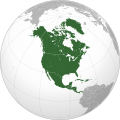
North America is a continent entirely within the Northern Hemisphere and almost all within the Western Hemisphere. In can also be described as a northern subcontinent of the Americas in models that use fewer than seven continents. It is bordered to the north by the Arctic Ocean, to the east by the Atlantic Ocean, to the west and south by the Pacific Ocean, and to the southeast by South America and the Caribbean Sea.
North America covers an area of about 24,709,000 square kilometers (9,540,000 square miles), about 16.5% of the earth's land area and about 4.8% of its total surface.
North America is the third largest continent by area, following Asia and Africa,[better source needed] and the fourth by population after Asia, Africa, and Europe. In 2013, its population was estimated at nearly 579 million people in 23 independent states, or about 7.5% of the world's population, if nearby islands (most notably around the Caribbean) are included.
North America was reached by its first human populations during the last glacial period, via crossing the Bering land bridge approximately 40,000 to 17,000 years ago. The so-called Paleo-Indian period is taken to have lasted until about 10,000 years ago (the beginning of the Archaic or Meso-Indian period). The Classic stage spans roughly the 6th to 13th centuries. The Pre-Columbian era ended in 1492, with the beginning of the transatlantic migrations—the arrival of European settlers during the Age of Discovery and the Early Modern period. Present-day cultural and ethnic patterns reflect interactions between European colonists, indigenous peoples, African slaves and their descendants.
Owing to Europe's colonization of the Americas, most North Americans speak European languages such as English, Spanish or French, and their states' cultures commonly reflect Western traditions.
This is a Featured article, which represents some of the best content on English Wikipedia.
The California Gold Rush (1848–1855) was a gold rush that began on January 24, 1848, when gold was found by James W. Marshall at Sutter's Mill in Coloma, California. The news of gold brought approximately 300,000 people to California from the rest of the United States and abroad. The sudden influx of gold into the money supply reinvigorated the American economy, and the sudden population increase allowed California to go rapidly to statehood, in the Compromise of 1850. The Gold Rush had severe effects on Native Californians and accelerated the Native American population's decline from disease, starvation and the California Genocide. By the time it ended, California had gone from a thinly populated ex-Mexican territory, to having one of its first two U.S. Senators, John C. Frémont, selected to be the first presidential nominee for the new Republican Party, in 1856.
The effects of the Gold Rush were substantial. Whole indigenous societies were attacked and pushed off their lands by the gold-seekers, called "forty-niners" (referring to 1849, the peak year for Gold Rush immigration). Outside of California, the first to arrive were from Oregon, the Sandwich Islands ( Hawaii), and Latin America in late 1848. Of the approximately 300,000 people who came to California during the Gold Rush, about half arrived by sea and half came overland on the California Trail and the Gila River trail; forty-niners often faced substantial hardships on the trip. While most of the newly arrived were Americans, the gold rush attracted thousands from Latin America, Europe, Australia, and China. Agriculture and ranching expanded throughout the state to meet the needs of the settlers. San Francisco grew from a small settlement of about 200 residents in 1846 to a boomtown of about 36,000 by 1852. Roads, churches, schools and other towns were built throughout California. In 1849 a state constitution was written. The new constitution was adopted by referendum vote, and the future state's interim first governor and legislature were chosen. In September 1850, California became a state. Read more...
List of Featured articles
|
|
|
This is a Good article, an article that meets a core set of high editorial standards.
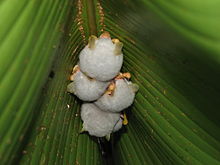 A roosting colony (Costa Rica) The Honduran white bat (Ectophylla alba), also called the Caribbean white tent-making bat, is a species of bat in the family Phyllostomatidae.
It is the only member of the genus Ectophylla.
The genus and the species were both scientifically described for the first time in 1892.
It has distinctive, entirely white fur, which is only found in six of the roughly 1,300 known species of bat.
It constructs "tents" out of understory plant leaves by strategically cutting the leaf ribs with its teeth; it roosts in these tents during the day.
It is a specialist frugivore, consuming almost exclusively the fruits of one species of fig.
Females can likely become pregnant twice per year, giving birth to one offspring at a time.
It is found in Honduras, Nicaragua, Costa Rica and western Panama at elevations from sea level to 700 m (2,300 ft).
Due to habitat loss, it is evaluated as near-threatened by the IUCN.
Its bright yellow ears, nose-leaf, and lips are a result of carotenoid deposition; the mechanism of this deposition is being researched as a way to understand and combat macular degeneration in humans. Read more...
[nil edit] Did you know...

- ... that the Chontal Maya of Tabasco consider themselves the direct descendants of the Olmec civilization?
|
|---|
|
- Basse-Terre, Guadeloupe (France)
- Basseterre, St. Kitts and Nevis
- Belmopan, Belize
- Bridgetown, Barbados
- Castries, St. Lucia
- Charlotte Amalie, U.S. Virgin Islands (US)
- Cockburn Town, Turks and Caicos (UK)
- Fort-de-France, Martinique (France)
- George Town, Cayman Islands (UK)
- Guatemala City, Guatemala
- Gustavia, St. Barthélemy (France)
- Hamilton, Bermuda (UK)
- Havana, Cuba
- Kingston, Jamaica
- Kingstown, St. Vincent and the Grenadines
|
- Kralendijk, Bonaire (Netherlands)
- Managua, Nicaragua
- Marigot, St. Martin (France)
- Mexico City, Mexico
- Nassau, The Bahamas
- Nuuk, Greenland (Denmark)
- Oranjestad, Aruba (Netherlands)
- Oranjestad, Sint Eustatius (Netherlands)
- Ottawa, Ontario, Canada
- Panama City, Panama
- Philipsburg, Sint Maarten (Netherlands)
- Plymouth (de jure) • Brades (de facto), Montserrat (UK)
- Port-au-Prince, Haiti
- Port of Spain, Trinidad and Tobago
|
- Road Town, British Virgin Islands (UK)
- Roseau, Dominica
- Saint-Pierre, St. Pierre and Miquelon (France)
- San José, Costa Rica
- San Juan, Puerto Rico (US)
- San Salvador, El Salvador
- Santo Domingo, Dominican Republic
- St. George's, Grenada
- St. John's, Antigua and Barbuda
- Tegucigalpa, Honduras
- The Bottom, Saba (Netherlands)
- The Valley, Anguilla (UK)
- Washington, D.C., United States
- Willemstad, Curaçao (Netherlands)
|
|
|
|---|
| Sovereign states | |
|---|
Dependencies and
other territories | |
|---|
Select [►] to view subcategories
[nil edit] Related portals[nil edit] Associated Wikimedia |